
Our Story
AVL derives its heritage from the designs and inspiration of Jim Ahrens (1906-2000), a mechanical engineer by trade who began designing looms in the 1930s. Beyond designing looms, Jim was also an mechanical engineer, machinist, production handweaver including contract weaving for department stores, weaving teacher at a local college and in his weaving school, and textile researcher for the U.S. Department of Agriculture. Jim sold and serviced his weaving equipment for nearly five decades (1940's - 1980's). These included side tie-up, rising shed & countermarch dobby, and dobby-draw looms, and the most advanced automatically moving heck-block warping creel and tension box the American handweaving world has ever seen. For more on Jim Ahrens, please visit Ahrens Looms website.
In the mid 60s, Jim began designing a radically different loom that combined the best parts of handweaving with his years of industrial knowledge. Jim's intent was to make hand weaving less frustrating and needlessly time consuming by introducing loom design improvments, especially where modern engineering and materials could improve on age old concepts. The pinnacle of his designs became our famous Production Dobby Loom. Soon thereafter, Jim received a large order of looms from Pat McGaw, director of the Pacific Basin School of Textiles in Berkley, CA. This took things to a whole new level, and in 1977 he joined forces with Jon Violette, a cabinet maker, and Ms. McGaw’s brother to form a new company called Ahrens & Violette Looms. The rest is, as they say, history!


Birth of the Compu-Dobby®
In early 1982, AVL made another breakthrough. This time, the inspiration came from Silicon Valley, where personal computers were starting to make big headlines. We realized that the dobby mechanism is essentially a computer using 1s and 0s as inputs. In other words the harness is either up or down. From there we made the relatively easy jump substituting solenoids and electronics for wooden bars and pegs. Tim Trudel produced our first software, Generation II, for the Apple II computer. It featured 32K of memory, ran in black and white on cassette tape and was a sensation! We’ve since had several software programs written for us from all over the world, including San Francisco, Syracuse, France and Oslo, Norway where our good friend and colleague, Bjørn Myhre (author of WeavePoint) resides. Our latest iteration, the Compu-Dobby 5, continues the tradition with surface mount electronics and multiple communication interfaces.
 .
. 
Changing of the Guard
The 1980's were a period of rapid growth. With wider market acceptance of game changing features like flyshuttle, dobby and automatic advance and tensioning systems, Production and Folding Dobby Loom sales boomed. To manage that growth, AVL reached maximum employment in its Orange Street facilities, which now included two full city blocks encompassing mutiple buildings. During this decade AVL expanded into high end textile CAD software with ProColorist/Colorado, dobby upgrades other brand looms (Baby Dobby), and expansion into 20 and 24 harness dobby configurations (Technical Dobby Loom). With expansion came changes in engineering, management and ownership. Jon & Robin Violette departed, making room for Peter Straus, AVL's longtime sales and marketing guru, to become the top executive. Towards the end of the decade we saw the emergence of Kim Mitchell, a longtime AVL machinist and Jim Ahrens apprentice, as he blossomed into a full fledged loom designer. With Peter's guidance and Kim's growing prowess, AVL reputation started its ascent to new heights.
New Looms for the 1990s
With Kim Mitchell coming into his own, the 1990s brought massive innovation in loom offerings, including:
- the Professional Dobby Rug Loom, which was the world’s first (and is now the only) commercially available hand-operated dobby rug loom. The AVL Rug Loom known for its ruggedness and capacity for complex weaving.
- the fully automated version of the Production Dobby Loom, called the Industrial Dobby Loom. This loom has become a hit for sampling and transition from pure handweaving into light industrial quantities.
- the Studio Dobby Loom, in conjunction with the world-famous weaver Ann Sutton of the U.K., specifically geared toward design studios and educational institutions.


Other new introductions included: automatic bobbin winder, a children's rigid heddle loom, sales of woven products produced by our customers, reconditioning of used AVL looms, and significantly, the beginning of our custom loom engineering services.
Passing of the Torch
As we moved into the 21st century, AVL made a big move, both literally and figuratively, moving into our new Morrow Lane facility in Chico. After years of mostly traditional wood working, modernization brought modern CAD and several CNC machines.
A famous Bob Dylan lyric goes, The Times They Are A-Changin, and this decade several important people depart along with several new faces joining our little company, including:
- Jim Ahrens - in his later years Jim had moved to Utah, and though he was no longer in close proximity, he remained a mentor and valuable contributor to AVL right up to the end when he passed in December of 2000.
- Jannie Taylor began her association with AVL. Ms. Taylor would eventually become our longest serving weaving teacher at the time of her passing in 2025. She was also an innovator bringing the game changing Warping Wheel into AVL's support equipment repertoire. Outside of AVL, Ms. Taylor became a world renowned teacher, specialzing in courses of her own creation that focused on complex weaving and advanced designing through modern software.
- After 26 years at AVL's helm, Peter Straus retired to teaching and heading the Center for Entrepreneurship at Chico State. Peter remains a principle advisor and AVL board member.
- Bob Kruger became the new President of AVL Looms, ushering in a revitalizing plan with an emphasis on ongoing product innovation.
On the prouduct side, the 2000s brought more AVL innovation, incluiding:
- the A-Series (in honor of Mr. Ahrens). The A-Series is our premier production handweaving loom with an amazing array of options to suit a range of productivity needs.
- the Jacq3G Jacquard loom. Our 3rd and most popular iteration of Jacquard. AVL engineers are honored to be walking in Monsieur Jacquard’s footsteps, though unlike the original, our system does not use wooden boards, but rather a sophisticated system of miniature solenoids to control each hook.
- the V-Series (in honor of Mr. Violette). This loom combines the simplicity of a traditional fixed breast and back beam with the sophistication of a computerized dobby and electric shed opening.
- the Workshop Dobby Loom, also known as the California Traveler (another J.Taylor-inspired product). Designed for traveling to workshops, this diminutive loom breaks down quickly to fit in the car.
- the aforementioned Warping Wheel. A real game changer for sectional weaving, the Warping Wheel is the first of its kind to allow a single person to perform sectional warping from a single cone!
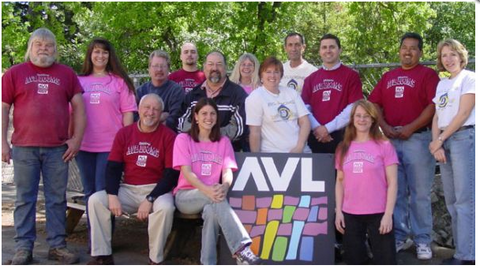
Front Row: Peter Straus, Rachel Hurlburt, Tracey Cannon Middle row: Dan Graves, Bridget Elmore, Steve Pientak, Kim Mitchell, Andrea Schefke, Bob Kruger, Jessie Meza, Debra Albert Back row: Shawn James, Sue Luna, Armindo Fonseca

The Next Stage
The new decade brought a new first, a move AVL-owned facilities. The new status allowed AVL to usher in more sustainable practices, including solar power. In the 2010s, we launched important new products, including:
- the Little Weaver tabletop dobby loom with its innovative shed opening mechanism tied to the beater movement.
- the K-Series (in honor of our longest serving employee and loom designer, Kim Mitchell).
Tectonic Shift: Bringing Hand Weaving into the New Millenium
In 2018 we entered new territory with the K-Series loom - our first counterbalance loom that made it possible for the first time to treadle up to 40 shafts without a lift assist system. More impressively, we implemented digital controls for the automatic cloth advance and warp tension systems, all controlled by our new web browser-based AVL Drive software developed specifically for the Compu-Dobby 5. What does all this technology do? Improve the weaving experience by leaps and bounds!
From left: Kaytie Allen, Scott Kilpatrick, Kim Mitchell, Jannie Taylor, Mai Lee Thao, Dianne Ayers, Richie, Marty, Marshall Ellis, Tracey Cannon, Steve Pientak, Ryan Utnehmer, Amy Foster and Bob Kruger.